
By Jaime Paul Lamb
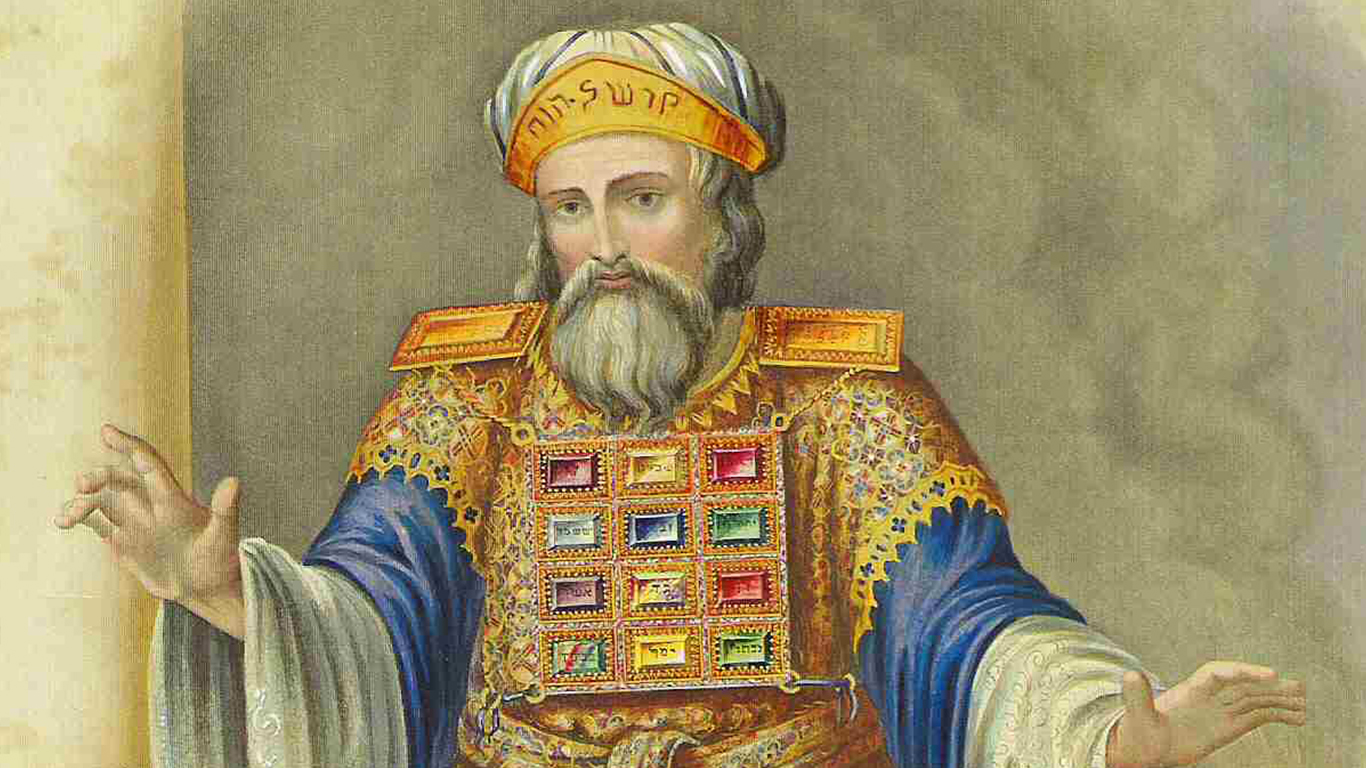
In the Royal Arch, or Seventh Degree of Capitular Masonry, the Most Excellent High Priest is described as being “dressed in a white robe, with a breastplate of cut glass, consisting of twelve pieces.” (Duncan’s, p. 219) Because the Breastplate was said to have been “designed […] as a place of deposit for the most priceless blessing of God to His fallen, erring children, a mode of ascertaining His will” (Strong), we have reason to suspect that it was used in a divinatory context. It is the purpose of the present piece to uncover the possible astrological significance of the Breastplate; its use in divinatory practices; and its significance in the attribution of gemstones to zodiacal signs.
The dimensions, construction and ornamentation of the priestly vestments have been described in minute detail elsewhere, so it is unnecessary to repeat that here. Suffice it to say that the High Priests of King Solomon’s Temple were described as wearing the Ephod, which was a ceremonial, tunic-like garment of “fine linen”, said to be distinct from the linen robe, typically worn by priests. (1 Chronicles 15:27) Affixed to the Ephod by golden rings, chains and ribbons was the Choshen Mishpet (Hebrew: “Breastplate of Judgement”), which was said to have contained a sort of purse into which the Urim and Thummim (Hebrew: “Lights and Perfections”) were placed. Twelve jewels, each representing one of the Twelve Tribes of Israel, were mounted on the Breastplate. The Book of Exodus gives the stones in the following order: sardius, topaz, carbuncle, emerald, sapphire, diamond, ligure, agate, amethyst, beryl, onyx and jasper. (Exodus 28:17-20) Though it is not explicitly identified as such in the Royal Arch ritual, the breastplate in question is almost certainly based on the biblical Choshen Mishpet, based on its description vis-à-vis that which we find in the Septuagint.
What I’d like to focus on in the present work is the possible astrological application of the twelve jewels upon the Chosen Mishpet, which were specifically mentioned to be connected with divinatory practices. (Exodus 28:30) This argument appears to have been first posited by the eminent historian, Josephus, who, in his Antiquities of the Jews (Book III, Ch. 7), gave the following cosmological interpretation of the Priest’s garments…
“The vestments of the high-priest being made of linen signifies the earth, the blue denotes the sky […] the ephod, […] the universe of four elements […] the breastplate to be placed in the middle of the ephod to resemble the earth, for that occupies the middle place in the world; and the girdle […] signifies the ocean for that goes about everything […] And the two sardonyxes that were in the clasps on the high-priest’s shoulder, indicate to us the sun and the moon. And for the twelve stones, whether we understand by them the months or the twelve signs of what the Greeks call the zodiac, we shall not be mistaken in their meaning.”
Interestingly, the Babylonian Captivity of the Jews would have coincided with the Babylonian codification of the zodiac – both of which were said to have occurred sometime during the 5th century BCE. This surely merits our consideration, as these astrological concepts would almost certainly had been absorbed into the cosmology of the Jews. There is, in fact, evidence of this zodiacal transmission in the description of the Cherubim, or Tetramorph, in Ezekiel’s Vision, wherein the angelic attendants to Yahweh’s Throne are described as having the face of an ox, lion, eagle and man. (Ezekiel 1:5-11) These four creatures correspond to the four fixed signs of the zodiac: Taurus, Leo, Scorpio and Aquarius, respectively. Ezekiel is said to have lived among the exiled Jews, and it is more-than-conceivable that the recently-organized Babylonian zodiac (in addition to the Lamassu sphinxes, who were formed of the same four zodiacal signs) was the symbolic inspiration for his celestial vision.
The Tetramorph of Ezekiel figures prominently elsewhere in the symbolism of Capitular Masonry, as evidenced by the creatures depicted on the Banner of the Royal Arch itself, as well as on the Four Veils of the Tabernacle. In terms of the assignment of the four fixed zodiacal signs, we find that Ephraim corresponds to the ox, or Taurus; Judah to the lion, Leo; Ben to the eagle, Scorpio (an ancient conflation, probably due to the proximity of the constellation Aquila); and Reuben to the man, Aquarius (the Water Bearer). The Royal Arch gives us one-third of the Tribe-zodiac attributions, but what of the others? Various authorities have assigned the Twelve Tribes of Israel to the twelve zodiacal signs, perhaps most notably in MacGregor-Mathers’ essay entitled “Twelve Signs and Twelve Tribes”. (See: Gilbert, The Sorcerer and His Apprentice, 1983) Similarly, Calmet’s Dictionary of the Holy Bible (1847) assigns the twelve gemstones on the High Priest’s Breastplate to the twelve zodiacal signs, thereby proposing another set of correspondences. It is also interesting to note that many histories of gemstones point to the Breastplate of the High Priest as representing a critical point in the development of zodiacal correspondences to precious and semi-precious stones. (See: Bauer, Precious Stones, 1968)
Hellenistic astrologers, particularly those in Alexandria during the first few centuries of the Common Era, were known to have calculated the natal position of the planets, as they were distributed in the zodiacal signs, on pieces of papyrus. The natal placements were then “translated” from the papyri to a Pinax, which was a board etched with an image of a zodiacal wheel, whereupon they were represented by various gemstones. The placements were then interpreted by an astrologer in consultation with the native of the chart. The implications are that the High Priest’s Breastplate may have been a Pinax-like component in astrological interpretive practices and that the corresponding stones helped to form the doctrine of gemstone-to-zodiac assignments.
In summary, there is evidence pointing to both the Breastplate’s divinatory use as well as to its zodiacal significance. It may be that the instrument was used as a Pinax, or some other component of astrological interpretation. The Breastplate also appears to have been instrumental in gemstone-to-sign attributions. In the context of the time, perhaps due to its proximity to the burgeoning Babylonian astrology, the Breastplate may well have been an instrument by which the High Priest was able to ascertain the “Will of God” or, in other words, the astrological causality of the Cosmos.
Works Referenced:
The Holy Bible, KJV
Josephus, Antiquities of the Jews
Duncan’s Masonic Ritual and Monitor, 1866
Mackey, An Encyclopaedia of Freemasonry, 1873
Bullinger, The Witness of the Stars, 1892
Strong, The Tabernacle of Israel: Its Structure and Symbolism, 2003
Hall, The Stone Horoscope: Evidence for Continuity of Ancient Esoteric Tradition and Practice, 2007
Jaime Paul Lamb is a consulting astrologer and taroist living in Phoenix, AZ. He is a member of the American Federation of Astrologers (AFA) and is certified in Hellenistic Astrology through Chris Brennan’s premier course on the subject. Lamb is the author of Myth, Magick & Masonry: Occult Perspectives in Freemasonry (The Laudable Pursuit, 2018), Approaching the Middle Chamber: The Seven Liberal Arts in Freemasonry and the Western Esoteric Tradition (The Laudable Pursuit, 2020) and The Archetypal Temple (Tria Prima, 2021). For more information, visit: www.jaimepaullamb.com.
Lamb is the Instructor for the Institute for Hermetic Studies course, Classical Astrology and the Western Esoteric Traditions. For more information click on the link below.
https://institute-for-hermetic-studies.teachable.com/courses/1788803