
THE TRUTH OF THE INWARD SILENCE
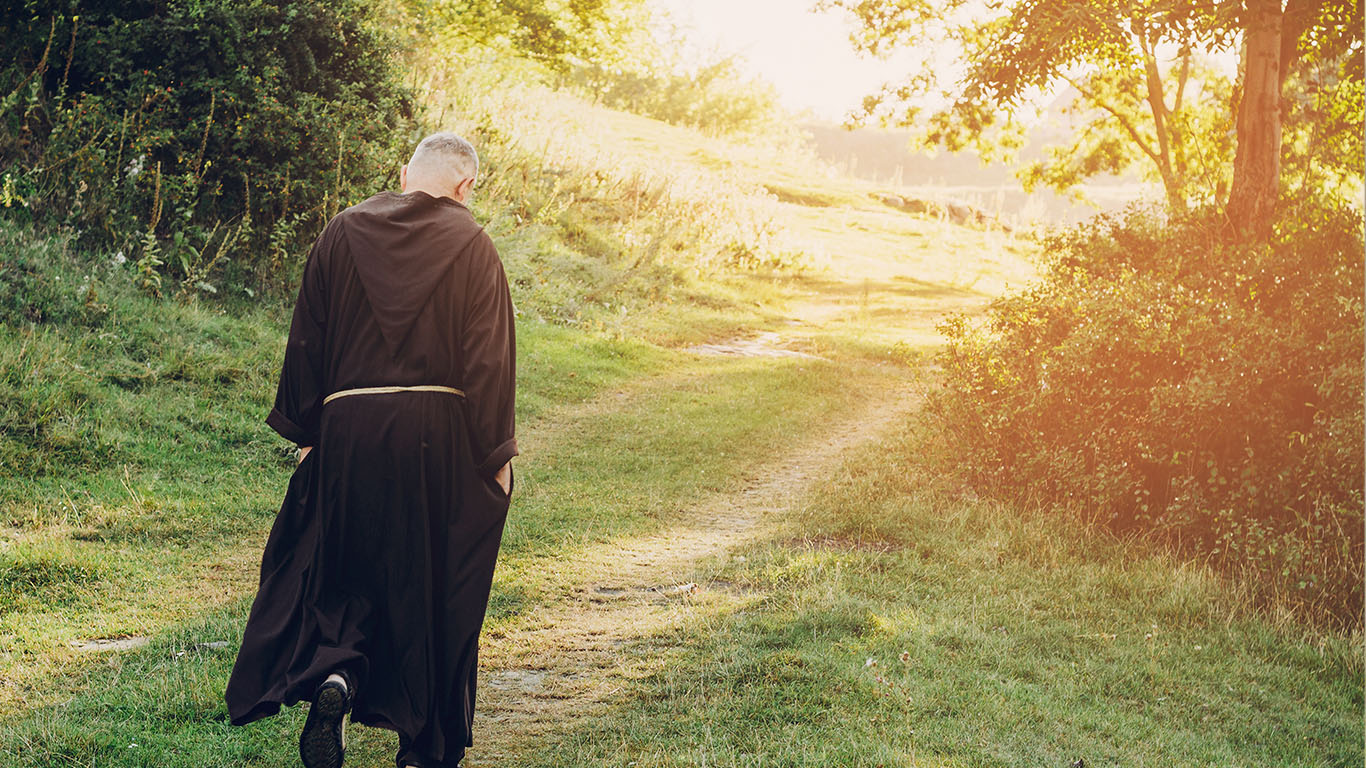
“Even this I desire of you, that your prayers may be simple, without a multiplicity of words, so that God, who pours out His Spirit upon the simple, may Himself be your prayer (author’s italics) – simple in thoughts, abandoning and not entertaining them, simple in understanding, depending wholly upon God.
“Suppose you find your mind dispersed; if you do but not consent to it, but continue your will to be present with your prayer for to love God, you will be acceptable in his love to God.
“For our parts, we should and can do so much as to refrain from all thoughts and words (those excepted to which the circumstances of our condition, business and office oblige us) and to avoid all rational cogitations, all forms and figures, not only during the time of our prayer but also all day long, that as soon as they appear we suppress them without admittance.
“I have long ago very well conceived how necessary it is not to suffer any though to enter into the mid, neither good not bad, and to be free from all figures and images in order to preform inward prayer.
“We ought not to believe that such a stated of inward Silence is indolence or loss of time. By no means: on them contrary, the soul is then more active than ever, since she is practicing faith, hope, and love: Faith is that she believes in God the Father, Son, and Holy Ghost, and is resigned to Him who is so truly present in her as He is in Heaven; Hope, since she would by no means abide in this state of inward silence and prayer if she did not hope thereby to please God; but she practices still better the virtue of Love, in that she is all this while resigned and given up to the Will of God.
KABBALAH
“ Ten Sepheroth of Nothingness,
Their gazing is like “a vision of a lightning flash,”
Their end has no limit,
And they speak of them “running and returning.”
In the hermetic-kabbalistic system propounded by Dion Fortune, and many others cabalistic schools in the West of the last one-hundred years or so, silence is attributed to the sphere of Binah, or Intelligence, on the Tree of Life consists of ten spheres, or sepheroth as they are called in Hebrew, represent the totality of creation from the highest to the lowest, all contained in the realm of Divinity. Each of the spheres is attributed to a virtue and a vice. Binah is among the highest three of these spheres, and silence is attributed to its domain.
In the kabbalah, Silence is seen as the great sign of Intelligence, for in silence our tongues are still and our minds are open. It is silence that speaks to us, and instructs us in the lessons of Creation, and the passage from spirit to material and back again; the specialty of the Great Mother Binah. It is the great Mother that controls the cycles of incarnation and rest, and it is in the Domain of Silence that we come to understand these great mysteries.
KRISHNA’S BATTLE WITH THE SERPENT
In the East, the knowledge of the power of silence and how to attain it is well understood. Silence is spoken of as being the “fourth” syllable of the sacred Word, or mantra, AUM. Aum, or OM, depending on how it is said, is the passageway to infinite bliss of the Cosmic. Through its constant repetition, many souls throughout the world have been initiated into the mysteries of life. By intoning the mantra OM, and letting it trail off into infinity and silence, the mind, emotions, and body are stilled, and the inner Light, Fire, and Love of the Soul of Souls is stirred into consciousness within us.
It is often said that OM is the Mother of all sounds, and all languages. It is the easiest sound to produce, and infants ofter speak it naturally. It is so simple that almost any variation of the basic sound will produce a peaceful feeling to the ones intoning it, either aloud or silently to themselves.
PSYCHOTHERAPY
In psychotherapy, silence is often used to produce states of extreme agitation or inner peace. While it may seem contradictory to say that silence can produce agitation, it is quite obvious to anyone who has ever tried to meditate how this occurs.. When we first attempt to still our minds, our thoughts and feelings rebel in a torrid of images produces themselves before our minds eye. While much of itinerary s nonsense, daily images or experiences , trivial things forgotten, after a while our inner ideas and feelings surface before us. Hopes is , dreams, fears, failures, repressed images and ambitions. All that we have tried to hide from, fear, or desire creates itself like a long forgotten ghost resurrected from the grave of our unconscious.
While some might question the usefulness of such an experience, under the proper conditions, with the proper motive, and control, it can be a means at discovering what it is that holds us back and checks us from living, loving, and knowing who we are what we can become. By accepting these less than desirable aspects of our self, learning how to redeem them, and integrating them into our psyche in a healthy and useful manner, we begin to grow in an organized and productive way. These inner demons that bar the way to the inner temple of silence become our servants once they are understood and accepted. When this happens, we can move into the real silence; the true inner spiritual silence that awaits us behind this self created barrier to peace.
The same technique is often used in larger group therapy sessions as well as to provoke a response from clients participating. Many people are unnerved by a silent room full of people. Often, someone will speak up because they have become nervous from the silence. When this occurs, others may speak, and then the therapist can direct the discussion to why they needed to speak, what was so troubling about the silence, and so forth. Psychological health and happiness can only occur when we are content with ourselves and to be ourselves. We can only truly be alone with ourselves when we are silent.
Some of the most effective methods for using silence in a psychological way, mixed with a strong dose of non-sectarian spirituality, is in Psychosynthesis. Psychosynthesis was developed in the early part of the twentieth century by the Italian psychiatrist, Roberto Assangioli. His writings and methods of dealing with the complex problems of psychological and spiritual growth became an organized school of thought in the 1960’s and numerous centers have been established throughout the world to promote the ever growing body of literature and methods of Psychosynthesis.
In his classic book on the techniques and philosophy of psychosynthesis, What We May Be, Piero Ferrucci discusses several uses of silence and methods for achieving that inner state.
While the techniques discussed by Ferrucci are in no means peculiar to psychosynthesis, that is they are shared by other systems of growth (both spiritual and strictly psychological) their very commonness is what gives them strength. Many people, and cultures, for ages have practiced them in some for or variation because they work. If they didn’t produce results, they would have been discarded millennia ago. These techniques consist of the following: receptive meditation, and the Temple of Silence.
Silence he notes has often been compared to a steady candle flame in the still air of a darkened room; or a body of water that is calm and one can see the bottom. Such silence is soothing, yet invigorating in the hidden, secret power that it holds ready to be made manifest. Early attempts to discover this state for ourselves often results in either an agitated state or restlessness, or a drowsy, sleepy state that is neither restful, nor profound.
In silence, we see wholes, gestalts, complete pictures instead of holes, fragments, limited ego centered perspectives. Dualism, and conflict are absorbed, giving way instantly to unity, peace, and clarity. When we release a problem to our inner self, we let it out of our hands and into the control of a stronger, more powerful, wise, and loving Self than our ego can provide. Such an experience is truly a healing experience, and can be compared to an inner purification. It is for this reason that many writers use the analogies of fire and water when describing their contacts with the Peace Within.
By focusing our mind on a single subject, visualizing it in detail, and taking it with us (or more accurately, allowing it to take us) inward, so that we forget who, what, and where we are, we can experience the healing peace. While many have tried this, and state that they can never fully block out the sounds and sensations coming into them from the environment, it is possible to develop a detached awareness where they fade into the background and no longer inhibit our journey.
In this silence, we come into contact with our Superconscious energies, or Higher (Spiritual) Self. Images may begin to form on our screen of awareness, some will be fleeting and we will not be able to remember them, others will impress with us an overwhelming sense of importance, even if at the moment they have no objective meaning to us. Such images are messages from our Self to our self. It is the awakening of the intuition, or the “still, small voice within” that when listened to leads us to greater power, health, and true, lasting peace. Symbols are used because as we tranced beyond thought, we go beyond words. Our emotional and mental selves are harmonized, and simultaneously, temporarily discarded. We experience what Zen Buddhism calls “the eternal moment.” Past and future are non-existent. All that exists is what we experience, and that is the present moment, the now.
As we listen more and more to our intuition, our mind and our emotions begin to take second place to our inner impulses. Our mind verifies what we receive, or translates it into a useful and meaningful message. Our emotions “feel” the appropriateness of our thoughts and our actions, and we begin to know what “feels right” both for our outer actions in the world, and our interpretations of our inner world. Our emotions become a means of screening out “false intuitions” from our objective mind, or our lower unconscious. Through such a safeguard we don’t attempt to identify, or act upon our temptations , weaknesses , or selfish desires as ‘intuitions’ or messages from our “higher self.”
SILENT MEDITATION
“Be still, and know that I AM God” (Psalm 46:10)
THE INNER TEMPLE OF SILENCE
“Then have them a Sanctuary for me, and I will dwell among them.” (Exodus 25:8)
The Inner Sanctuary for time immemorial has been an effective technique for attuning to our highest, Inner Self and experiencing the Silence. The ancient Jewish mystics, or Merchavah (Chariot) mystics would mentally create different “chambers” known as Hekolot, or Temples (sometimes translated as Palaces) to which they would so completely envelope their consciousness that they would know only of what they had visualized and lose all awareness of the physical world for a while. Upon returning, they wrote down their experiences and talked of meetings with divine beings, angels, fierce guardians of the inner realms, and at the end of it all, in the highest chamber – the Silence of God.
In the Middle Ages, Jewish, Christian, Sufi, and other mystics told of similar experiences in their journeys to the inner realms through creating an Inner Temple.
While many of these individuals followed complex and highly disciplined paths under experienced teachers for years, all of them began their journeys with a simple visualization of the Temple of the Divine as they imagined it. As they continued on their Inner Journeys, and learned in the Silence of God within them, they ceased needing external teachers, for God alone became their teacher, friend, companion, and Divine Lover.
Ample instructions for creating an “inner temple” exist across the literature and can be found in the course work and publications of the Institute for Hermetic Studies. For more information on this very detailed topic see: Egregores: The Occult Entities That Watch Over Human Destiny by Mark Stavish and The Experience of Eternity by Jean Dubuis.
LIVING IN THE SILENCE
“I have seen you in the sanctuary and beheld your power and glory” (Psalm 63:2)
The more we enter into the Inner realms that make up our psyche and listen to the voice of intuition that speaks to us from the confines of the Holy of Holies, our Divine Self, the more we hear what it has to say. Trusting and acting upon our intuitions is the only way to increase our awareness of them , keep them flowing, and lead lives that are loving, powerful, centered, and directed by the Silence. If we ask we must be willing to listen; if we hear, we must be willing to act.