
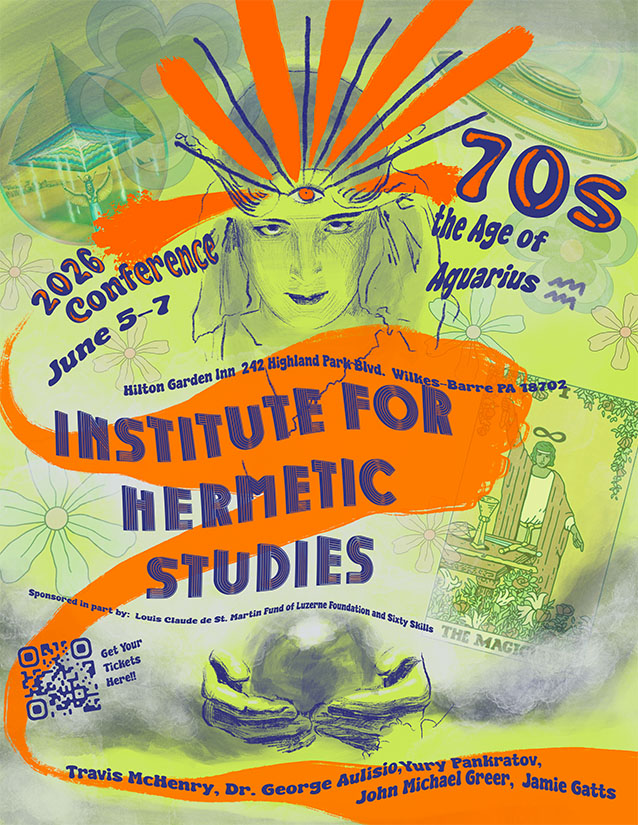
June 5-7, 2026
Hilton Garden Inn
242 Highland Park Blvd, Wilkes-Barre Township, PA 18702
Wilkes-Barre, Pennsylvania
Admission: $75
The conference may be attended in person, via Zoom, or viewed afterwards as a recording. Please include your name and contact information, and inform us if you will be attending in person when registering with the link below.
Hotel Reservations: Those wishing to stay at the conference venue may use the following link for discounted hotel rooms.
Hilton Hotel Room Reservation Link
Thank You To Our Sponsors!
This year’s conference sponsors include: Sixty Skills, Louis Claude de St. Martin Fund (Luzerne Foundation), and our many Unknown Superiors who make this and previous events possible.
ONE – Title: Tie-dyed Tarot: Illustrating Counterculture Spirituality
Abstract: The 1970s marked an important period of transition for tarot cards. Riding the counterculture wave of the 1960s, which embraced esoteric symbols as part of the New Age rebellion against established religions, tarot came out of the shadows of occult magicians and began to enter the mainstream. Colorful, funky decks like the Aquarian Tarot and Morgan-Greer Tarot sought to combine the essence of deep spirituality while appealing to a younger crowd raised on Technicolor and tie-dye. This talk explores the variety of tarot cards released during the 1970s and how they impacted the greater tarot world even while drawing on historical designs.
Presenter: Travis McHenry
Bio: One of the foremost occultists of the modern era, Travis McHenry has written books on the history of the tarot and a memoir about his ten-year research study into paranormal phenomena. A native of rural Pennsylvania (Bloomsburg), Travis grew up surrounded by the folklore of the Appalachian Mountains, which shaped his desire to uncover and share the historical truths hidden behind mythological stories. His decks are well known best sellers in the modern world of Tarot symbolism.
TWO – Title: The Problem of Evil in The Exorcist: Identity, Existentialism, and Jesuit Consolation
Abstract: The Exorcist, widely regarded as an occult classic of the 1970s, is examined here as a philosophical engagement with the problem of evil, particularly the suffering of the young and innocent. This talk places the film in conversation with questions of identity, existentialism, and the Jesuit tradition of consolation and desolation, focusing largely on the figure of Fr. Damien Karras, S.J., portrayed by Scranton native and University of Scranton graduate Jason Miller. By attending to the film’s central themes and figures, the talk considers enduring questions about evil and the search for meaning, as well as the film’s own efforts to address them.
Presenter: Dr. George Aulisio
Bio: George Aulisio is the Dean of the Weinberg Memorial Library and Director of the Schemel Forum. He holds the faculty rank of Professor. He has a B.A. in Philosophy from Bloomsburg University, an M.S. in Library and Information Science from Drexel University, an M.L.A. in Philosophy and Metaphysics from the University of Pennsylvania, and a Ph.D. in Philosophy from Temple University. He oversees all aspects of the Weinberg Memorial Library, including its fundraising efforts. He also administers the Hope Horn Art Gallery and the Schemel Forum, a community education program of The University of Scranton. He also teaches in the Department of Philosophy and is an active scholar of philosophy and library & information science.
THREE – Title: Samizdat Sorcery – Occult Texts and Homemade Cosmologies in Late-Stage Socialism
Abstract: The Soviet Union presented itself as the triumph of rational materialism, yet beneath this surface a parallel cosmology persisted. Denied access to formal religious or occult institutions, Soviet spiritual seekers built their own out of scraps they could find. Behold the colorful world of Soviet esoteric underground in the 1970s, from typewritten copies of esoteric books to improvised magical systems assembled from fragments of philosophy, folklore, and contraband texts. Circulating through samizdat networks, these materials formed a distinctly Soviet occult culture: diverse, resourceful, hybrid, and shaped by scarcity.
Presenter: Yury Pankratov
Bio: Born in the hard-edged industrial town of Dzerzhinsk, Russia, and raised by a pack of wild books, Yury is known for his English translations of Russian esoteric literature. Having studied Western magic and occult thought for over a decade, he also blogs about esoteric topics at
russianesotericism.substack.com. Yury lives in Charlotte, North Carolina.
FOUR – Title: The Morning of the Magicians: 1970s Pop Culture, Alternative Realities, and the Revival of Occultism
Abstract: The current revival of occultism in the United States and the Western world generally had its roots in the alternative-realities boom of the 1970s, when a conjunction of complex cultural forces made a great many people willing to take rejected knowledge seriously. During that decade, occultism was simply one thread in a hallucinatory tapestry that blended Asian religions, drug trips, flying saucers, lost continents, forgotten sciences, and some of the most colorful frauds of the modern era. It was out of this context that occultism gradually evolved its own subculture, publishing venues, and public presence. This guided tour of a decade of weirdness, highlighted by lurid paperback covers, points up aspects of the occult revival that are thankfully long past – and a few that might be worth bringing back.
Presenter: John Michael Greer
Bio: Born in the gritty Navy town of Bremerton, Washington and raised in the south Seattle suburbs, John Michael Greer began writing stories nearly as soon as he could hold a pencil. He is the author of more than eighty published books on a galaxy of subjects and also writes a widely cited blog at Ecosophia.net. An initiate in Druidic, Gnostic, Martinist, and Masonic lineages, he served as Grand Archdruid of the Ancient Order of Druids in America (AODA) for twelve years. He lives in Silver Spring, Maryland.
Five – Title: Hans Holzer: The Godfather of Modern Parapsychology
Abstract: This presentation examines the rise of Hans Holzer as a formative figure in modern paranormal investigation, highlighting his attempt to apply systematic, research-oriented methods to phenomena long dismissed as superstition or folklore. Holzer’s methodology emphasized historical documentation, environmental observation, and detailed case records, positioning paranormal investigation within a quasi-scientific framework. In the cultural climate of the 1970s—particularly in the wake of The Exorcist(1973) and the resulting surge of public interest in demonology, spirit possession, and occult phenomena—Holzer became widely known for his investigations of haunted locations and alleged possession cases. His controversial yet influential use of psychic mediums as investigative instruments aligned with the era’s broader fascination with altered states of consciousness and metaphysical inquiry. Through prolific publishing, media visibility, and highly publicized cases, Holzer both reflected and shaped the occult revival of the 1970s, helping to normalize paranormal investigation within popular culture while establishing methodological practices that continue to influence contemporary ghost hunting and paranormal research.
Presenter: Jamie Gatts
Bio: Jamie Gatts is a well know figure in the Pennsylvania parapsychology community. An avid collector of “Fate Magazine” and other 1970s psychic paraphernalia, she is a popular presenter at conferences, and is the owner-operator of Haunt Coffee LLC (Wilkes-Barre Township), where weekly events are the talk of the town.
In addition, we have one or two surprise presenters from whom we are awaiting confirmation of their participation making this an exceptional event this year. As usual, Friday evening is social time, Saturday is the main series of events, with a half-day of presentations Sunday morning. The complete schedule will be updated when presenter travel needs are confirmed.
Please subscribe to VOXHERMES as this page is subject to updates as needed.
Friday, June 5 – Informal Meet and Greet (7pm onward)
Saturday, June 6
9:00 – 9:45 am – Conference Registration and Check-In
9:45-10:00am – Introductions
10:00 – 11:00 – Jamie Gatts – Hans Holzer: The Godfather of Modern Parapsychology
11:00-11:15 – Break
11:15-12:15 – Dr. George Aulisio – The Problem of Evil in The Exorcist: Identity, Existentialism, and Jesuit Consolation
12:15-1:45 – Lunch
1:45-2:45 – Travis McHenry – Tie-dyed Tarot: Illustrating Counterculture Spirituality
2:45-3:00 – Break
3:00 – 4:00 – Yury Pankratov – Samizdat Sorcery – Occult Texts and Homemade Cosmologies in Late-Stage Socialism
4:00-4:15 – Break
4:15 – 5:15 – John Michael Greer – The Morning of the Magicians: 1970s Pop Culture, Alternative Realities, and the Revival of Occultism
5:15 – 7:30 Dinner
7:30 – 8:30 – Dr. Andrea Nerozzi – Mystery Presentation and Social
Sunday, June 7
Program Description
9:30am- 11:00am – Panel Q&A
Enjoy this free preview of the 2026 conference with John Michael Greer, Mark Stavish, and Ike Baker
June 5-7, 2026
Hilton Garden Inn
242 Highland Park Blvd, Wilkes-Barre Township, PA 18702
Wilkes-Barre, Pennsylvania
Admission: $75
The conference may be attended in person, via Zoom, or viewed afterwards as a recording. Please include your name and contact information, and inform us if you will be attending in person when registering with the link below.
Hotel Reservations: Those wishing to stay at the conference venue may use the following link for discounted hotel rooms.
Hilton Hotel Room Reservation Link
Thank You To Our Sponsors!
This year’s conference sponsors include: Sixty Skills, Louis Claude de St. Martin Fund (Luzerne Foundation), and our many Unknown Superiors who make this and previous events possible.
ONE – Title: Tie-dyed Tarot: Illustrating Counterculture Spirituality
Abstract: The 1970s marked an important period of transition for tarot cards. Riding the counterculture wave of the 1960s, which embraced esoteric symbols as part of the New Age rebellion against established religions, tarot came out of the shadows of occult magicians and began to enter the mainstream. Colorful, funky decks like the Aquarian Tarot and Morgan-Greer Tarot sought to combine the essence of deep spirituality while appealing to a younger crowd raised on Technicolor and tie-dye. This talk explores the variety of tarot cards released during the 1970s and how they impacted the greater tarot world even while drawing on historical designs.
Presenter: Travis McHenry
Bio: One of the foremost occultists of the modern era, Travis McHenry has written books on the history of the tarot and a memoir about his ten-year research study into paranormal phenomena. A native of rural Pennsylvania (Bloomsburg), Travis grew up surrounded by the folklore of the Appalachian Mountains, which shaped his desire to uncover and share the historical truths hidden behind mythological stories. His decks are well known best sellers in the modern world of Tarot symbolism.
TWO – Title: The Problem of Evil in The Exorcist: Identity, Existentialism, and Jesuit Consolation
Abstract: The Exorcist, widely regarded as an occult classic of the 1970s, is examined here as a philosophical engagement with the problem of evil, particularly the suffering of the young and innocent. This talk places the film in conversation with questions of identity, existentialism, and the Jesuit tradition of consolation and desolation, focusing largely on the figure of Fr. Damien Karras, S.J., portrayed by Scranton native and University of Scranton graduate Jason Miller. By attending to the film’s central themes and figures, the talk considers enduring questions about evil and the search for meaning, as well as the film’s own efforts to address them.
Presenter: Dr. George Aulisio
Bio: George Aulisio is the Dean of the Weinberg Memorial Library and Director of the Schemel Forum. He holds the faculty rank of Professor. He has a B.A. in Philosophy from Bloomsburg University, an M.S. in Library and Information Science from Drexel University, an M.L.A. in Philosophy and Metaphysics from the University of Pennsylvania, and a Ph.D. in Philosophy from Temple University. He oversees all aspects of the Weinberg Memorial Library, including its fundraising efforts. He also administers the Hope Horn Art Gallery and the Schemel Forum, a community education program of The University of Scranton. He also teaches in the Department of Philosophy and is an active scholar of philosophy and library & information science.
THREE – Title: Samizdat Sorcery – Occult Texts and Homemade Cosmologies in Late-Stage Socialism
Abstract: The Soviet Union presented itself as the triumph of rational materialism, yet beneath this surface a parallel cosmology persisted. Denied access to formal religious or occult institutions, Soviet spiritual seekers built their own out of scraps they could find. Behold the colorful world of Soviet esoteric underground in the 1970s, from typewritten copies of esoteric books to improvised magical systems assembled from fragments of philosophy, folklore, and contraband texts. Circulating through samizdat networks, these materials formed a distinctly Soviet occult culture: diverse, resourceful, hybrid, and shaped by scarcity.
Presenter: Yury Pankratov
Bio: Born in the hard-edged industrial town of Dzerzhinsk, Russia, and raised by a pack of wild books, Yury is known for his English translations of Russian esoteric literature. Having studied Western magic and occult thought for over a decade, he also blogs about esoteric topics at
russianesotericism.substack.com. Yury lives in Charlotte, North Carolina.
FOUR – Title: The Morning of the Magicians: 1970s Pop Culture, Alternative Realities, and the Revival of Occultism
Abstract: The current revival of occultism in the United States and the Western world generally had its roots in the alternative-realities boom of the 1970s, when a conjunction of complex cultural forces made a great many people willing to take rejected knowledge seriously. During that decade, occultism was simply one thread in a hallucinatory tapestry that blended Asian religions, drug trips, flying saucers, lost continents, forgotten sciences, and some of the most colorful frauds of the modern era. It was out of this context that occultism gradually evolved its own subculture, publishing venues, and public presence. This guided tour of a decade of weirdness, highlighted by lurid paperback covers, points up aspects of the occult revival that are thankfully long past – and a few that might be worth bringing back.
Presenter: John Michael Greer
Bio: Born in the gritty Navy town of Bremerton, Washington and raised in the south Seattle suburbs, John Michael Greer began writing stories nearly as soon as he could hold a pencil. He is the author of more than eighty published books on a galaxy of subjects and also writes a widely cited blog at Ecosophia.net. An initiate in Druidic, Gnostic, Martinist, and Masonic lineages, he served as Grand Archdruid of the Ancient Order of Druids in America (AODA) for twelve years. He lives in Silver Spring, Maryland.
Five – Title: Hans Holzer: The Godfather of Modern Parapsychology
Abstract: This presentation examines the rise of Hans Holzer as a formative figure in modern paranormal investigation, highlighting his attempt to apply systematic, research-oriented methods to phenomena long dismissed as superstition or folklore. Holzer’s methodology emphasized historical documentation, environmental observation, and detailed case records, positioning paranormal investigation within a quasi-scientific framework. In the cultural climate of the 1970s—particularly in the wake of The Exorcist(1973) and the resulting surge of public interest in demonology, spirit possession, and occult phenomena—Holzer became widely known for his investigations of haunted locations and alleged possession cases. His controversial yet influential use of psychic mediums as investigative instruments aligned with the era’s broader fascination with altered states of consciousness and metaphysical inquiry. Through prolific publishing, media visibility, and highly publicized cases, Holzer both reflected and shaped the occult revival of the 1970s, helping to normalize paranormal investigation within popular culture while establishing methodological practices that continue to influence contemporary ghost hunting and paranormal research.
Presenter: Jamie Gatts
Bio: Jamie Gatts is a well know figure in the Pennsylvania parapsychology community. An avid collector of “Fate Magazine” and other 1970s psychic paraphernalia, she is a popular presenter at conferences, and is the owner-operator of Haunt Coffee LLC (Wilkes-Barre Township), where weekly events are the talk of the town.
In addition, we have one or two surprise presenters from whom we are awaiting confirmation of their participation making this an exceptional event this year. As usual, Friday evening is social time, Saturday is the main series of events, with a half-day of presentations Sunday morning. The complete schedule will be updated when presenter travel needs are confirmed.
Please subscribe to VOXHERMES as this page is subject to updates as needed.
Friday, June 5 – Informal Meet and Greet (7pm onward)
Saturday, June 6
9:00 – 9:45 am – Conference Registration and Check-In
9:45-10:00am – Introductions
10:00 – 11:00 – Jamie Gatts – Hans Holzer: The Godfather of Modern Parapsychology
11:00-11:15 – Break
11:15-12:15 – Dr. George Aulisio – The Problem of Evil in The Exorcist: Identity, Existentialism, and Jesuit Consolation
12:15-1:45 – Lunch
1:45-2:45 – Travis McHenry – Tie-dyed Tarot: Illustrating Counterculture Spirituality
2:45-3:00 – Break
3:00 – 4:00 – Yury Pankratov – Samizdat Sorcery – Occult Texts and Homemade Cosmologies in Late-Stage Socialism
4:00-4:15 – Break
4:15 – 5:15 – John Michael Greer – The Morning of the Magicians: 1970s Pop Culture, Alternative Realities, and the Revival of Occultism
5:15 – 7:30 Dinner
7:30 – 8:30 – Dr. Andrea Nerozzi – Mystery Presentation and Social
Sunday, June 7
Program Description
9:30am- 11:00am – Panel Q&A
Enjoy this free preview of the 2026 conference with John Michael Greer, Mark Stavish, and Ike Baker